



Delivered as one complete package, not as standalone surveys, isolated cleaning or inspection-only visits. Every stage is connected, from identifying the cause through to remediation follow-up, environmental stabilisation and hygiene verification.
We are increasingly called to properties where multiple companies have already attempted remediation. The visible mould was wiped away. The treatment was applied. And within weeks or months — sometimes sooner — the growth returned.
The reason is almost always the same. The underlying moisture, ventilation or building-performance issue was never identified, evidenced or stabilised. The contamination was treated as a surface problem. The environment that produced it was left untouched.
That is the gap we exist to close.
This is not cleaning work. It is a structured remediation package designed to identify the contributing factors, stabilise the environment, reduce recurrence risk, and verify the outcome against measured evidence.
In most properties we attend, visible mould is the symptom — not the cause. Five contributing factors recur. Identifying which apply, and in what combination, is the first step before any remediation begins.
Ongoing humidity imbalance
Indoor relative humidity sustained outside the 40–60% range — a hospitable environment for spore germination and surface condensation.
Ventilation deficiencies
Extract systems undersized, blocked, switched off, or never specified for the occupancy load. Stale air retains moisture.
Cold bridging
Common in extensions and perimeter walls. Cold surfaces fall below dew point and condense moisture out of the air.
Heating control limitations
Intermittent or zoned heating that allows surfaces to cool, then re-warm — driving repeated condensation cycles in affected rooms.
Hidden moisture within materials
Saturated plaster, masonry or insulation behind finishes — undetectable by eye, only revealed by capacitance, pin-type and thermal instruments.
Before any remediation, we carry out a structured diagnostic assessment. This allows us to understand the moisture behaviour of the building, not just treat what is visible. Only once the cause is identified do we remediate and stabilise the environment properly.
Moisture mapping
Pin, pinless and masonry-comparison readings across surfaces and substrates, building a moisture distribution map of affected and adjacent areas.
Pin · Pinless · Masonry
Dew point vs surface temperature
Surface temperature compared against calculated dew point at prevailing RH. Where surface drops below dew point, condensation is occurring.
Condensation Risk Output
Airflow evaluation
Ventilation performance assessed against Approved Document F. Extract rates, fresh air provision, and stagnation zones identified room by room.
Approved Document
Thermal imaging correlation
Infrared imaging correlated with moisture and dew point data. Cold bridges, missing insulation and concealed moisture pathways made visible.
Annotated Thermal Record
Environmental readings
Logged RH, temperature and ventilation-performance data collected on site. The baseline against which any post-remediation result is verified.
RH · Temp · Vent Evidence
Many moisture companies provide system-based solutions involving ventilation installations or pressurisation units. Our position is different. Our reports are investigative documents first — not product pathways.
This is the core of how we work. We are not an extension of a product line. Our recommendations are not constrained by what we need to sell you to be paid.
Our reports are investigative documents first — not product pathways.
If ventilation improvements are required, we specify the required capacity and reasoning so the homeowner can source solutions independently through their preferred contractor.
This keeps our advice independent, evidence-based and focused on diagnosis — not on selling a system.
Investigation, remediation and verification are delivered as a single, structured engagement — because separating them is what causes recurrence. The objective is not just to remove mould, but to reduce recurrence risk properly.
Individually scoped engagement
Pricing is confirmed after an initial review of the property, location, reporting and required remediation pathway.
Delivered as a single, structured engagement — assessment, remediation, stabilisation and verification under one scope. This is not surface cleaning, and it is not an inspection-only visit. The objective is to identify the contributing factors, stabilise the environment and reduce recurrence risk against documented evidence.
On-site Diagnostic Assessment
Structured investigation of moisture behaviour, ventilation, dew point and environmental readings — using calibrated instruments.
Root Cause Identification
Contributing factors named, evidenced and documented before remediation begins.
Antimicrobial Remediation
Controlled remediation to ANSI/IICRC S520 — containment, removal of contamination and substrate restoration.
Post-Remediation Antimicrobial Treatment
Targeted treatment of affected surfaces and substrates to neutralise residual contamination.
Environmental Stabilisation
Humidity, ventilation and temperature brought back into specification — the conditions that allowed growth, corrected.
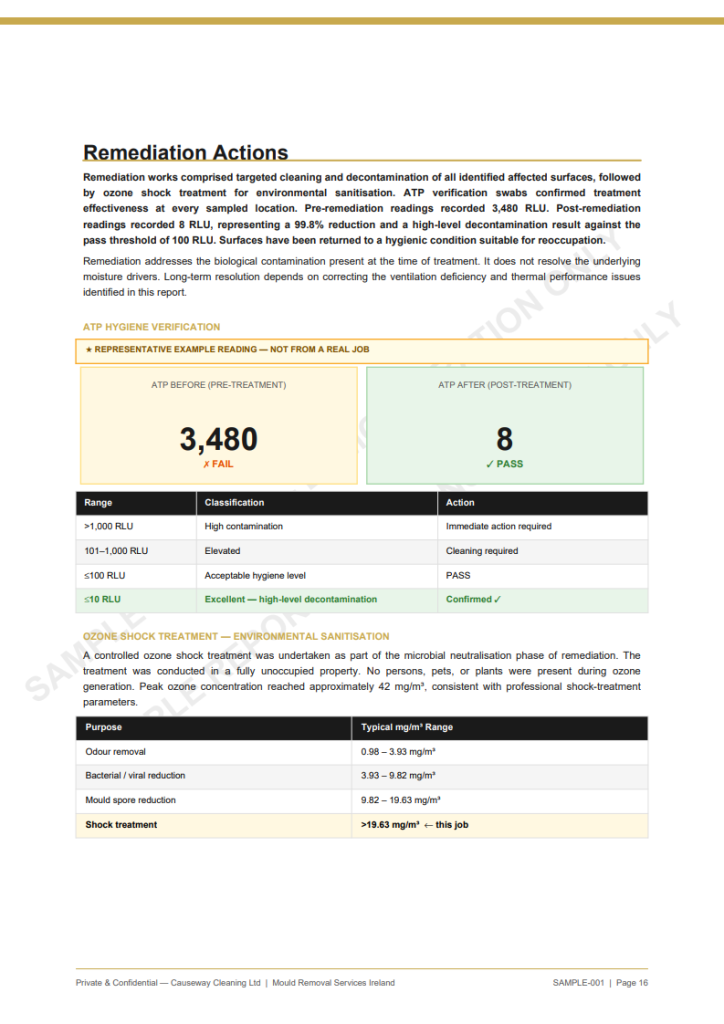
ATP Hygiene Verification — Before & After
Measured evidence recorded at start and finish. Sign-off only against documented hygiene results.
Full Property Sanitisation
Applied throughout the affected envelope where diagnosis or scope requires it.
Compliance-Ready Documentation
Structured report supporting homeowner, landlord, property manager and public-sector requirements.
Our reports are investigative documents first — structured records of moisture behaviour, diagnostic findings, remediation works carried out, and measured verification before sign-off. Reviewing one is the fastest way to see how our methodology differs from cosmetic treatment.
Our work follows recognised guidance for mould remediation, moisture management and building performance — delivered to a documented standard suitable for compliance and public-sector engagement.
ANSI/IICRC S520
Mould Remediation Standard — the recognised reference for assessment, containment, removal and verification.
BS 5250
Management of Moisture in Buildings — informs how condensation risk is assessed and remedied.
Approved Documents C, F & L
Resistance to moisture, ventilation, conservation of fuel — the regulatory context our work operates within.
Registered public sector supplier in Ireland — delivering structured, compliance-ready remediation services to housing bodies, local authorities, and property managers.
SupplyGov.ie ID — 24186
Our remediation process aligns with recognised environmental and restoration standards — and is delivered to a documented professional standard.
Some properties benefit from additional stabilisation measures. These are optional services and must be requested before scheduling — both are installed during the service visit.
Light-Activated Anti-Mould Protective Coating
A specialist coating applied after remediation to help discourage microbial regrowth on higher-risk surfaces. The coating activates with natural or artificial light — where light levels are low, dedicated activation lighting can be used.
— External walls & window reveals
— Wardrobes and enclosed spaces
— Bathrooms and high-humidity areas
— Reduces regrowth risk on treated surfaces
Must be requested before scheduling — applied during the service visit.
Discreet Post-Remediation Data Loggers
For rental properties, second homes, or clients wanting reassurance, we install discreet data loggers that evaluate how the property behaves after remediation — confirming whether humidity remains within safe ranges.
— Humidity and temperature trends, logged
— Identification of ongoing moisture risks
— Documented environmental evidence
— Supports landlord, manager & compliances cases
Monitoring equipment is installed during the service visit — please request in advance.
If you want the issue diagnosed, treated and documented as part of a structured remediation process, we can help. Our role is to identify what is driving the mould, carry out the necessary remediation and provide a clear record of the work completed.
+353 1 265 5971
+44 2895 600 105
info@mouldremovalservice.ie
77 Camden Street Lower,
Dublin, D02 XE80, Co. Dublin